by Sarah Koerber
WATER IN FOOD PRODUCTS functions as a reaction medium, reactant, oxidizer, and structural component. Water activity (aw) affects food chemistry and can be controlled by removal (dehydration or drying) or by chemically binding the water, reducing its activity. Water activity in foods ranges from 0.95 to 1.00 in fresh meats and vegetables to 0.20 in dried milk.
Humectants are additives that bind water and control aw. Although humectants have applications in many industries - pharmaceutical, cosmetic, veterinary - the focus here is on humectants in foods. Water activity reduction achieved by adding humectants to food enhances stability, maintains texture, and reduces microbial activity.
Humectant use in foods is widespread and has a long history. Salt and sugar are the oldest, most widely used humectants. Other commonly used humectants include sorbitol, glycerol, and propylene glycol. Humectants are widely available from domestic suppliers with prices around $0.30/lb for sugar, $1.00/lb for sorbitol, and $0.10/lb for salt.
As food additives, humectants must meet several criteria for acceptance: safety, lack of adverse odors and flavors, nutritional value, economy, and ease of use. A primary benefit is the reduction of microbial activity in foods, achieved through reduction of aw to less than 0.90.
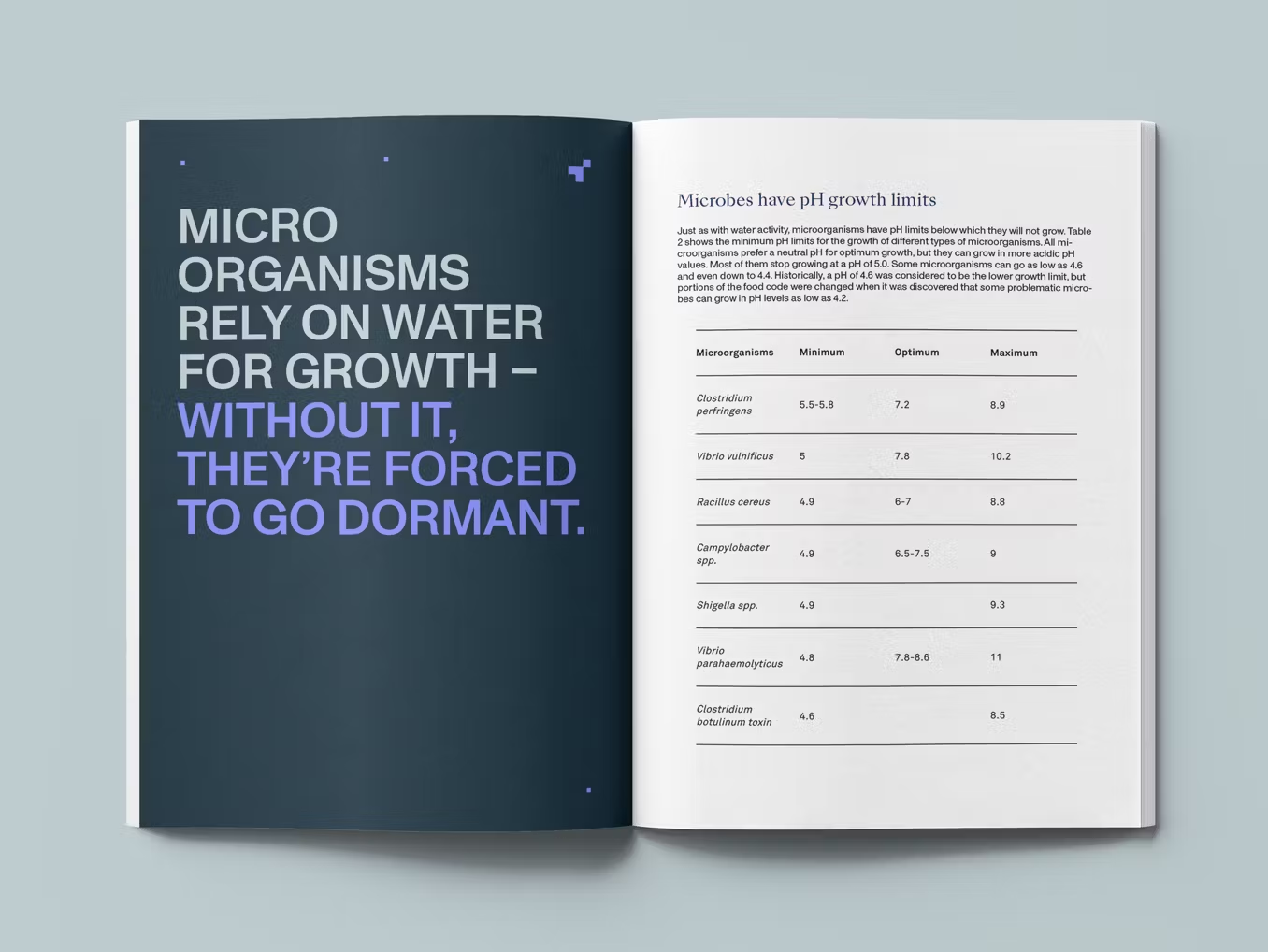
Rates of degradation due to microbial action increase with higher water activities. Many common bacteria proliferate at aw > 0.9. Some yeasts can develop at aw as low as 0.6 to 0.7, requiring either additional lowering of aw or addition of antimicrobial agents. Microbial activity can be reduced by drying foods, thereby lowering the moisture content and aw, but the addition of humectants reduces aw, while retaining moisture.
Blending, moist infusion, and dry infusion methods are commonly used to treat foods with humectants. Blending involves mixing the product with a humectant solution and requires that the food product be mixed or homogenized. With moist infusion, the food product is soaked in the humectant solution. Dry infusion involves first drying or dehydrating the product and then soaking it in the humectant solution.
Sloan et.al (1977) used propylene glycol, sucrose, and sodium chloride to achieve water activities of 0.78 or 0.79 in semi-moist dog food. Linko et. al (1985) predicted aw of 0.85 in cereal-based products using a combination of sugar (7%), glycerol (2%), propylene glycol (1%), and salt (1.5%) under certain extrusion conditions. Ledward (1985) discussed development of intermediate moisture meats and concluded that a water activity less than 0.85 could be achieved using glycerol as 15 to 45% of the food product.
Research indicates some of the difficulty in achieving low aw in foods through the addition of humectants. The humectant propylene glycol has intrinsic antimicrobial properties; however, its use in food is limited. Kapsalis et. al (1985) studied the potential of polyglycerols and polyglycerol esters as humectants in food and generally found them to be objectionable due to taste and odor characteristics.
Effective measurements of aw becomes an important aspect of quality control in the food industry, since shelf life and food quality depend on aw. In turn, the ability to predict the effects of humectants on aw is important for the purpose of calculating use and effectiveness of humectants. Sloan and Labuza (1976) accurately predicted aw resulting from the addition humectants to semi-moist dog food and achieved a range of water activities from 0.81 to 0.98.
Intermediate moisture foods (IMFs) are sufficiently moist to eat Òas isÓ and have aw low enough to prevent bacterial growth. Typical water contents range from 10 to 40%, with water activities ranging from 0.6 to 0.9. Jams, some cheeses, dried fruits are traditional IMFs. IMFs manufactured with humectants for human consumption have become a target of increasing interest, but development has been slow due to problems related to consistency, texture, and flavor changes caused by humectants. Public perception of potential toxicological properties of food additives has also limited widespread development of IMFs for human consumption.
Recent applications have focused on developing IMFs for use in space programs and the military. The addition of humectants to fresh meats can reduce the water activity into ranges that allow for storage without refrigeration. Cubed meat products produced with glycerol, gelatin, and sorbitol have aw of 0.61 to 0.79.
Water content and water activity remain areas of high importance in the food industry. The ability to influence aw through the addition of humectants to food products continues to be an area of active research in the development of wholesome, flavorful foods for human consumption.
Brimelow, C.J.B. 1985. A pragmatic approach to the development of new intermediate moisture foods. In Properties of water in foods, D. Simatos and J.L. Multon, eds. Martinus Nijhoff Publishers, Dordrecht, The Netherlands.
Kapsalis, J.G., D.H. Ball, D.M. Alabran, and A.V. Cardello. 1985. Polyglycerols and polyglycerol esters as potential water activity reducing agents, chemistry and sensory analysis. In Properties of water in foods, D. Simatos and J.L. Multon, eds. Martinus Nijhoff Publishers, Dordrecht, The Netherlands.
Labuza, T.P. 1985. Water binding of humectants. In Properties of water in foods, D. Simatos and J.L. Multon, eds. Martinus Nijhoff Publishers, Dordrecht, The Netherlands.
Ledward, D.A. 1985. Novel intermediate moisture meat products. In Properties of water in foods, D. Simatos and J.L. Multon, eds. Martinus Nijhoff Publishers, Dordrecht, The Netherlands.
Linko, P., R. Kervinen, R. Karppinen, E.K. Rautalinna, and J. Vainionp... 1985. Extrusion cooking for cereal-based intermediate-moisture products. In Properties of water in foods, D. Simatos and J.L. Multon, eds. Martinus Nijhoff Publishers, Dordrecht, The Netherlands.
Pomeranz, Yeshajahu. 1991. Functional properties of food components, second edition. Academic Press, Inc. New York.
Sloan, A.E., D. Schlueter, and T.P. Labuza. 1977. Effect of sequence and method of addition of humectants and water on aw lowering ability in and IMF system. Jour. Food Science. Vol. 42. 94-96.
Sloan, A.E. and T.P. Labuza. 1976. Prediction of water activity lowering ability of food humectants at high aw. Jour. Food Science. Vol. 41. 532-535.
Sloan, A.E., P.T. Waletzko, and T.P. Labuza. 1976. Effect of orderof- mixing on aw lowering ability of food humectants. Jour. of Food Science. Vol. 41. 536-540.
Troller, J.A. and J.H.B. Christian. 1978. Water activity and food. Academic Press, New York.